

SHIBUY.A. × WATCH

Shibuya creates a sustainable urban management model by supporting city operating costs through station-front advertising
2026-03-30
SHARE
The area in front of Shibuya Station is adorned with countless advertisements. A portion of the revenue generated from advertisements placed in public spaces is used by the Shibuya Station Area Management Association to support urban initiatives such as cleaning, disaster prevention, and events. How does integrating advertising in public spaces into urban management create a sustainable system?
Establishing an urban management model unique to Shibuya that utilizes public spaces
Standing in front of Shibuya Station, one is inevitably greeted by numerous advertisements. While these are commercial messages aimed at people visiting Shibuya, they are also an important element in shaping the city's landscape. The visuals, which change day and night, are like a screen projecting the activity of the city of Shibuya. In fact, some of the advertisements displayed around the station provide financial resources to support the activities of the Shibuya Station Area Management Association.
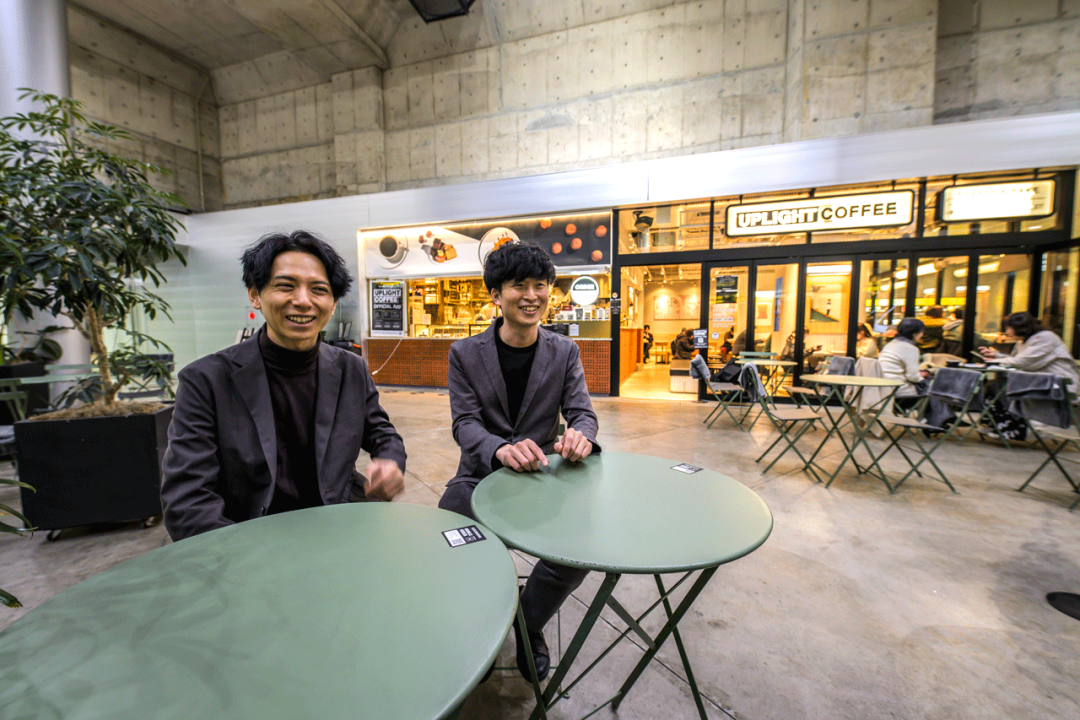
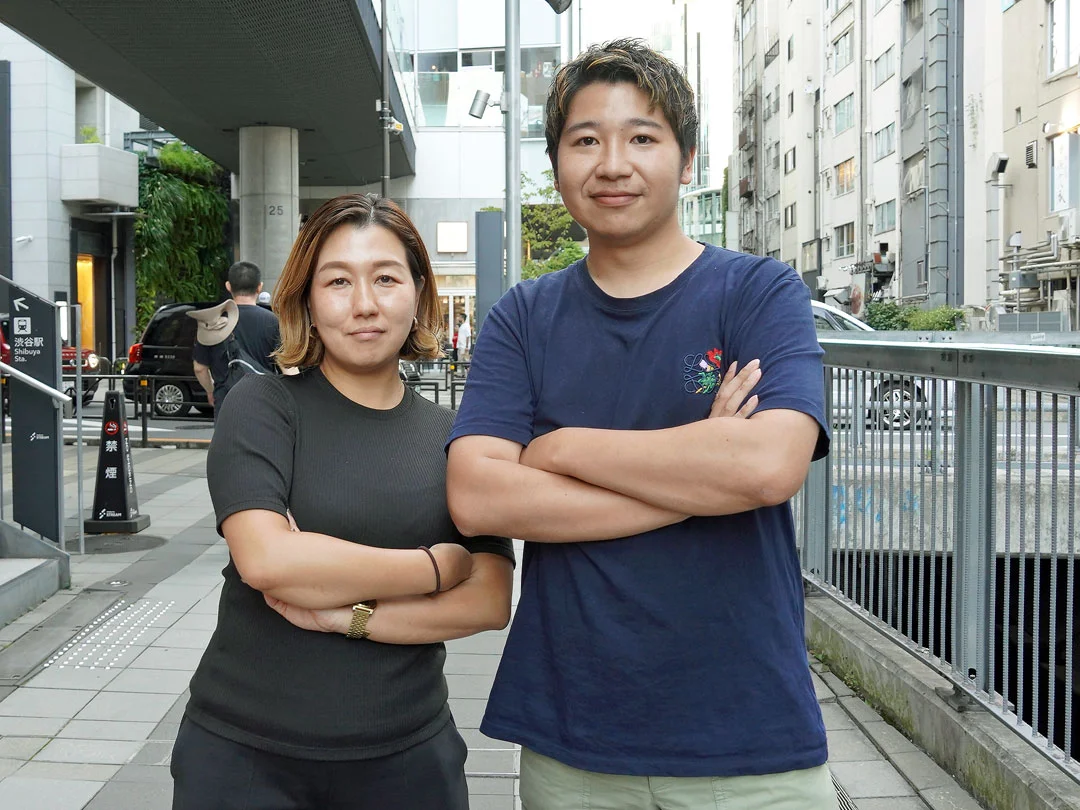
We spoke with Takashi Isomoto (left) and Yugo Kashiwagi (right), who are in charge of advertising for the Shibuya Station area management.
"Our advertising business has two meanings. First, it is a major source of revenue for area management that supports urban development. Second, through advertising, we aim to create a Shibuya-like landscape that everyone can enjoy," says Takashi Isomoto, Assistant Head of Operations Group.
The Shibuya Station Area Management team is involved with nearly 30 different advertising media. Representative examples include the "Shibuya Charter Sheet" and "Center Sheet" in Hachiko Square, the "Eyedrop Wall Sheet" and "SHIBUYA SCRAMBLE SQUARE Vision" on SHIBUYA STREAM Deck, and the wrap-around advertisements on the pedestrian deck. Many of these media are striking, and it's likely that many people will recognize them and think, "Oh, that's that ad!" These advertisements, which blend seamlessly into the station area, don't exist in isolation; they function in conjunction with the surrounding landscape.
Behind the scenes, the lively advertising supports cleaning and disaster prevention activities
Shibuya Station Area Management is a general incorporated association that is responsible for a wide range of activities, including beautification of the area around the station, crime and disaster prevention, landscape creation, event management, and information dissemination. Advertising revenues from utilizing the public space in front of the station form the foundation that supports these activities.
"The funds are mainly used for roads and urban development," says Yugo Kashiwagi. "Roads are used for cleaning and maintenance, while urban development is used for crime prevention, disaster prevention, graffiti prevention, and events."
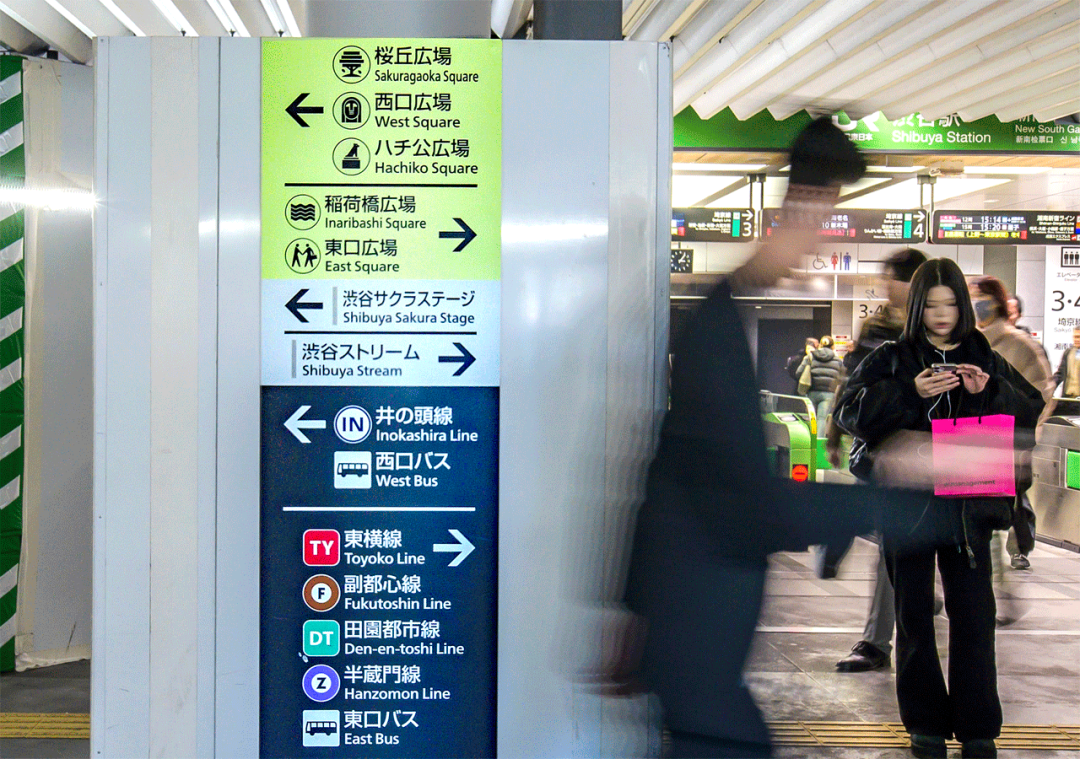
He also designs and installs guide signs in public spaces, helping to organize the flow of people and supporting safe and smooth urban operations.
In this way, the advertisements that adorn the streets of Shibuya serve not only as corporate promotions but also as maintenance funds for the public space. The advertisers come from a wide range of industries, including anime, music, beverages, finance, and live concert announcements.
"Recently, there has been an increase in anime and music-related events. However, it's not biased towards a specific industry. Shibuya has a strong influence, so there are also requests to use this space to announce events being held in cities other than Shibuya," says Kashiwagi.
Maintaining a perfect balance between freedom of expression and dignity as a public space
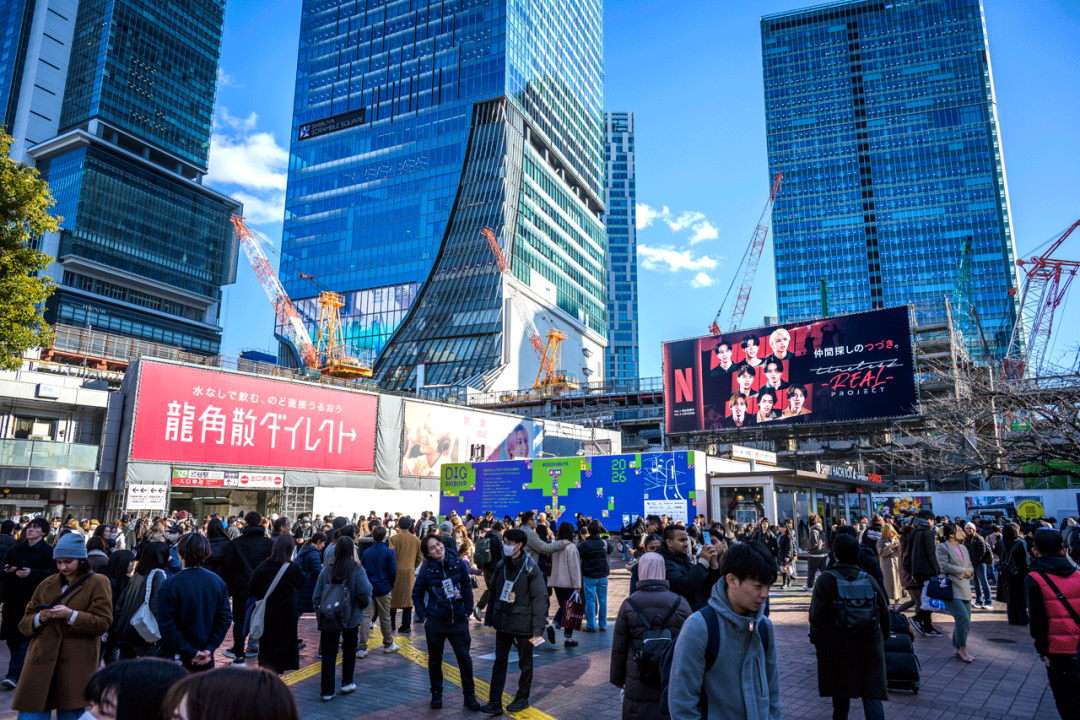
The advertisements in Hachiko Square. These advertisements contribute to the distinctive Shibuya landscape.
The "Charter Sheet" displayed at the front of Hachiko Square and the "Center Sheet" extending above it are representative media for area management advertising. By "taking over" these together, it is possible to create a unified worldview throughout the entire square.
"When the charter sheet and center sheet are displayed together, they stand out even from a distance. It's a medium that allows for a dynamic development that is typical of Shibuya," says Kashiwagi.
In addition, around Shibuya Station there are many advertising media unique to Elimane that make good use of public spaces.
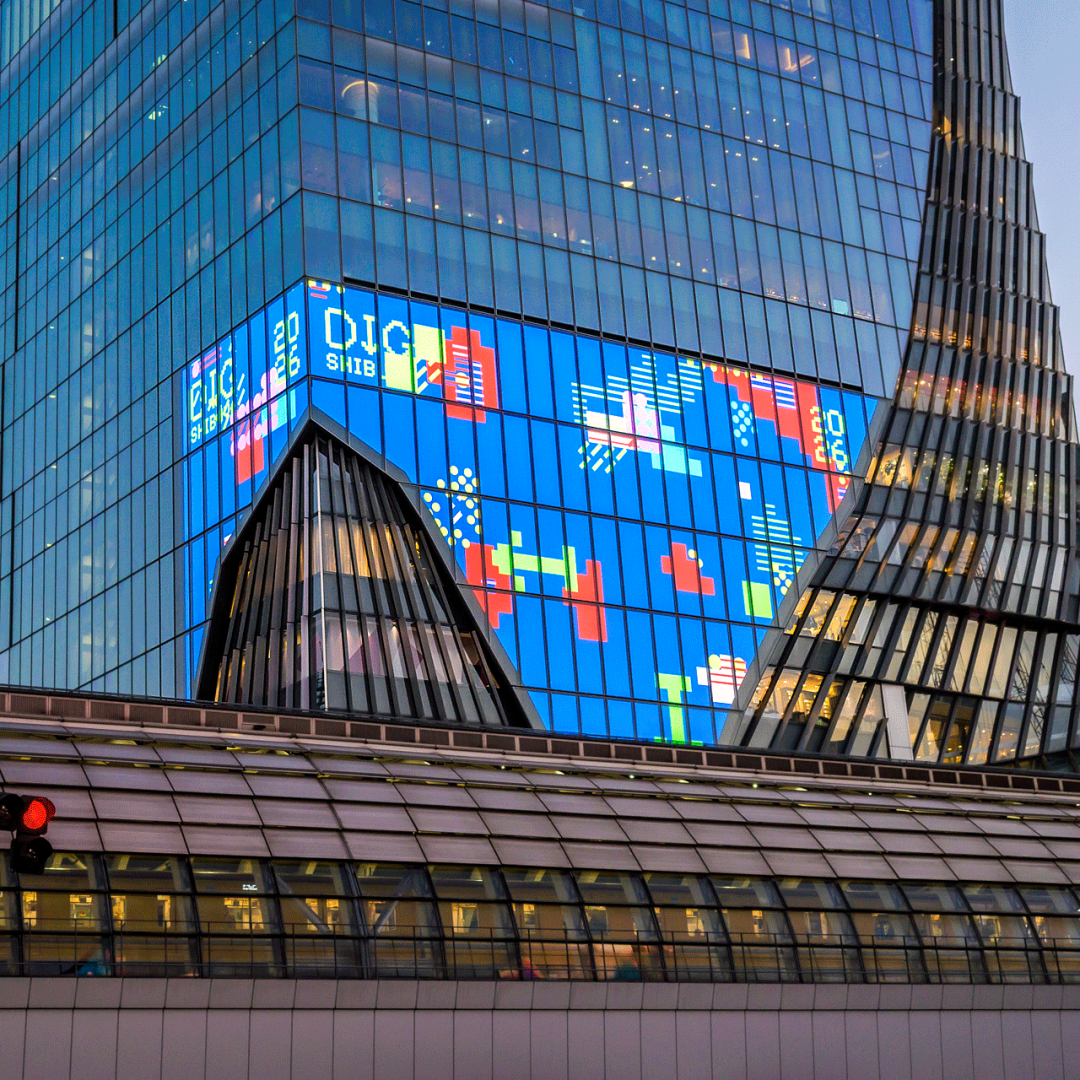
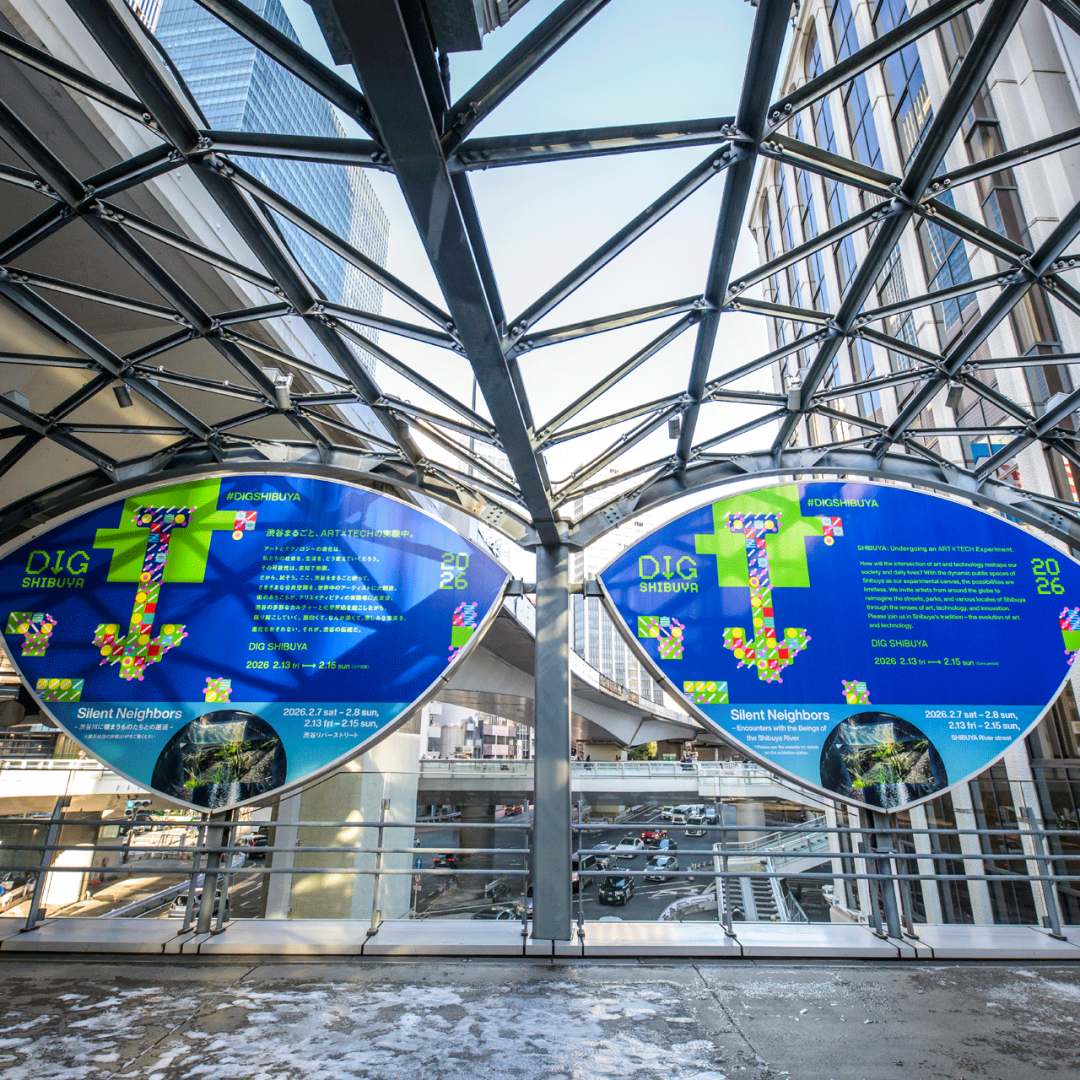
Left) Large digital signage on the exterior wall of SHIBUYA SCRAMBLE SQUARE. Visuals linked to the city's activities add color to the space in front of the station. Right) "Eyeball Wall Sheet" at SHIBUYA STREAM Deck. Its impressive form accents the landscape in front of the station.
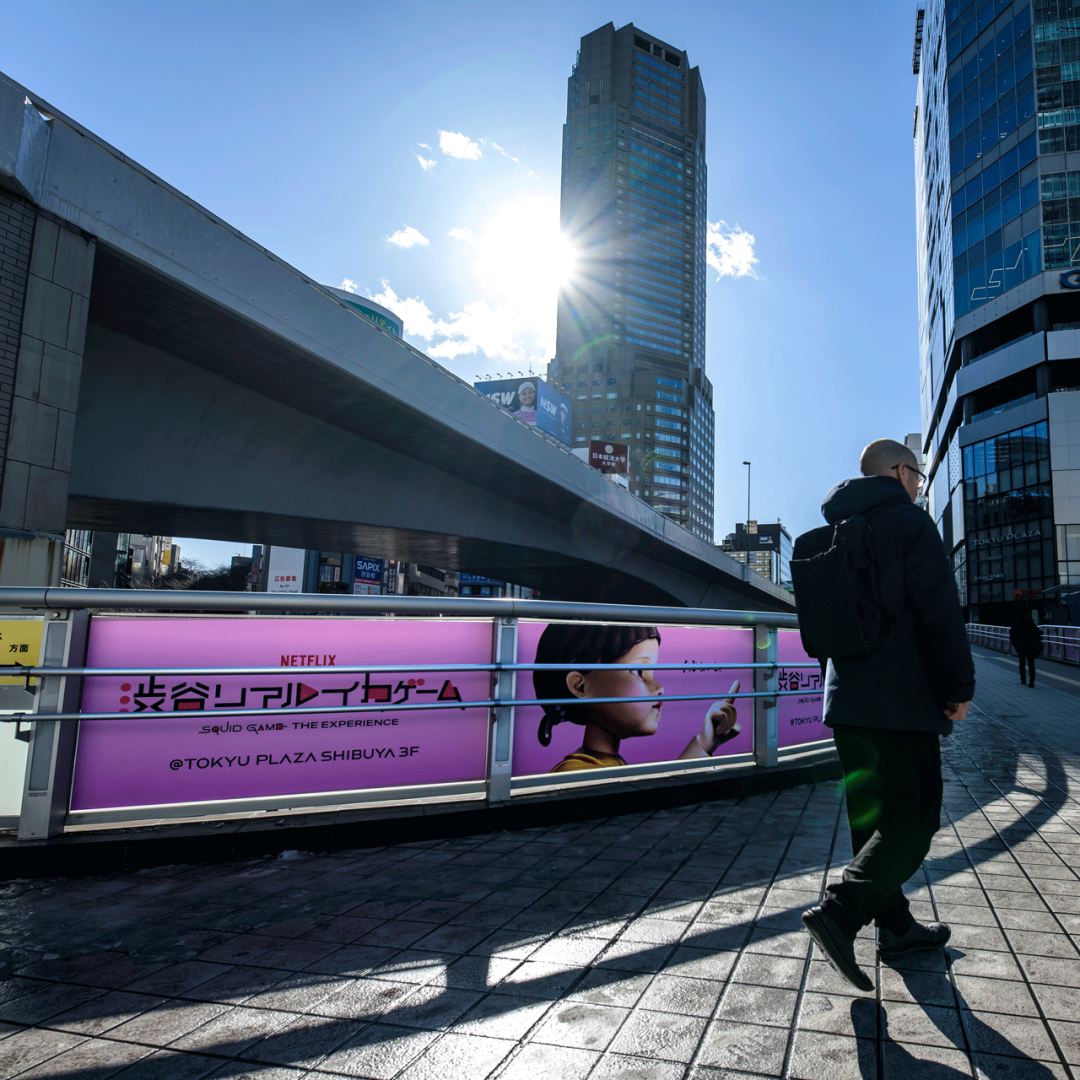
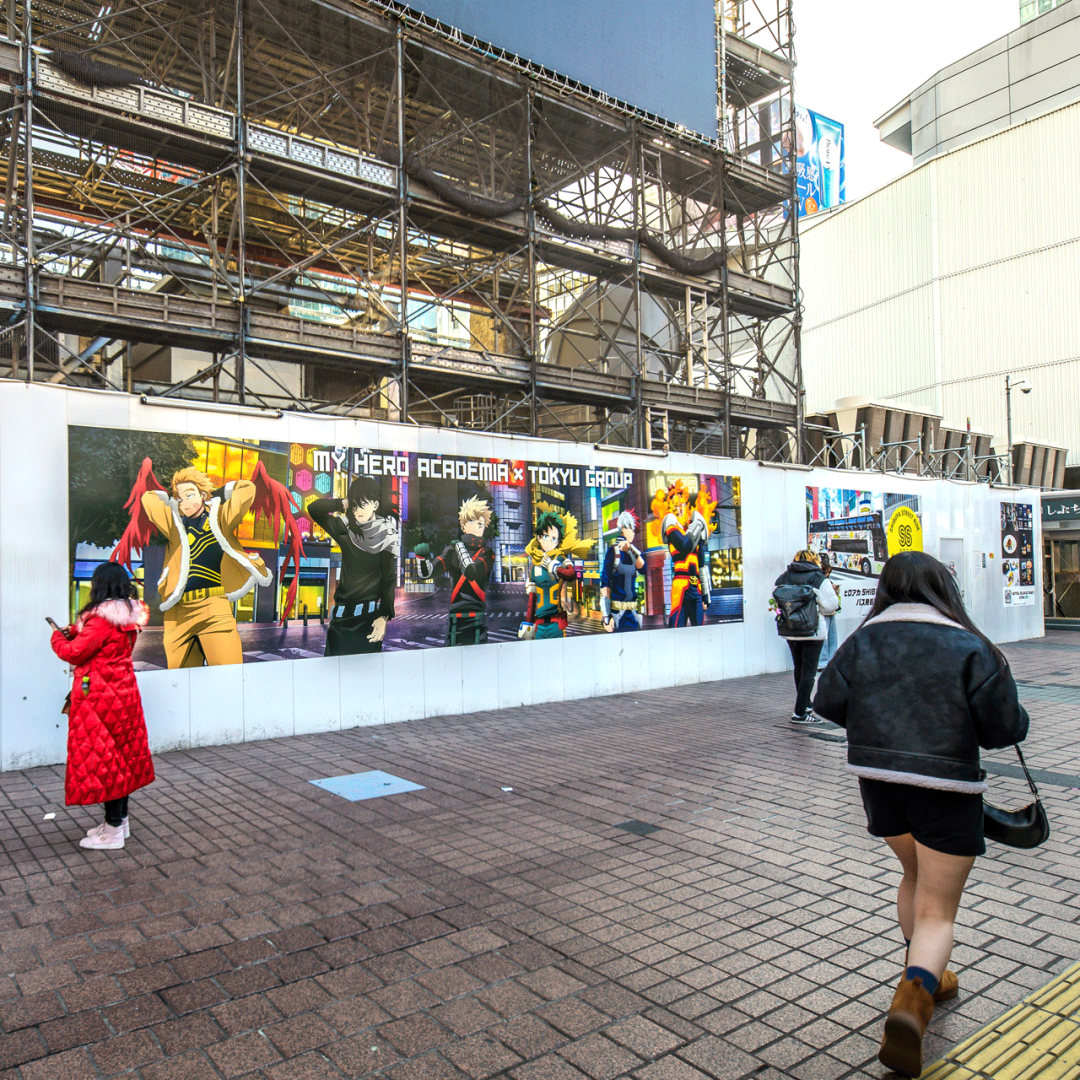
Left) Advertising sheet on the "Shibuya Station West Exit National Highway Deck" connecting Shibuya Fukuras and Shibuya Sakura Stage Right) Advertising sheet on the temporary construction fence wall of Hachiko Square
The entire square can be taken over by anime and music content, allowing for free expression in a Shibuya-like way. However, this does not mean that expression is disorderly.
"People tend to think that because it's Shibuya, we can try anything, but because it's a public space, we have to maintain its dignity. The most difficult point is finding the balance between Shibuya's unique character and preserving the landscape," says Kashiwagi.
Consideration of the flow of people is also essential. For advertisements featuring popular idols, there is a possibility that crowds may gather for the purpose of taking photos, so careful consideration is given to whether or not to install them.
"If there is any danger to public spaces, we may have to make a contract to remove the advertisements even during the period. We make sure that our clients fully understand these points as we move forward," says Kashiwagi.
The East Building connecting corridor wall sheet, which has relatively more space, is often used to display photos of idols and other celebrities. In such cases, measures such as the deployment of security guards will be considered.
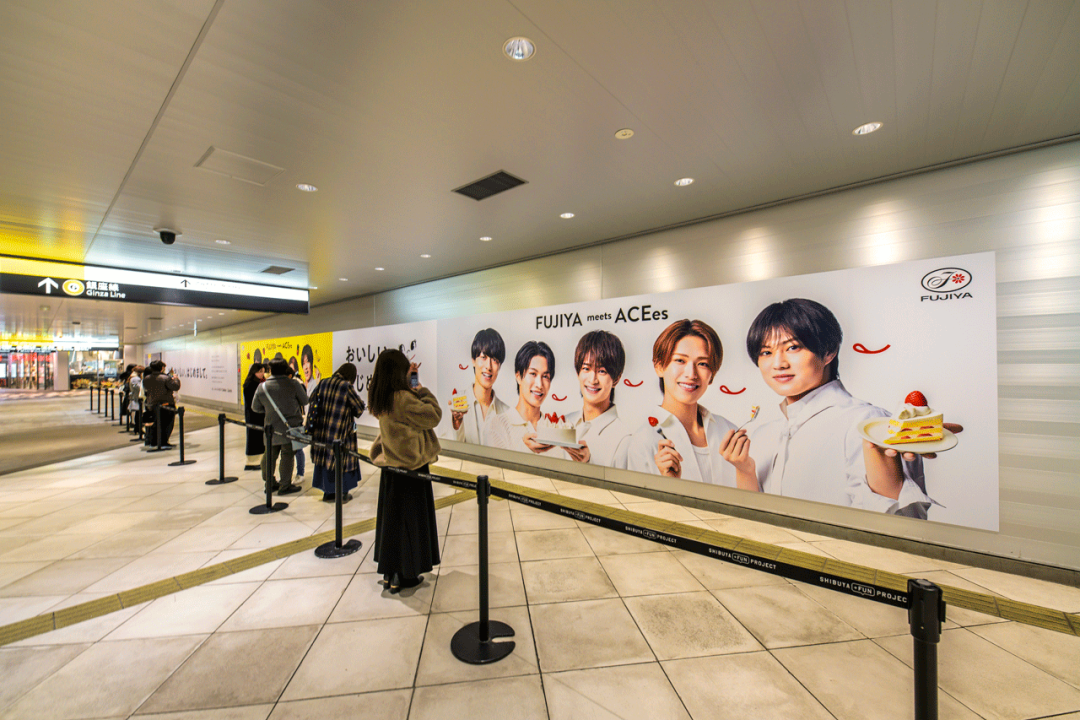
People gather at the "East Building Connecting Passage Wall Sheet" in the East Exit Underground Plaza to take photos with their favorite idols.
More than just advertising, it's a system that supports city management
In addition to advertising media, the Hachiko Square also houses the "SHIBU HACHI BOX," a tourist information facility. Opened in 2020, this facility was established by Shibuya Station Area Management after obtaining road occupancy permits, as an updated version of its predecessor, the Aogaeru Tourist Information Center. The Shibuya Ward Tourism Association is responsible for its operation, providing tourist information and disseminating information about the city. Like the advertising, it can be considered an example of an initiative that utilizes public space.
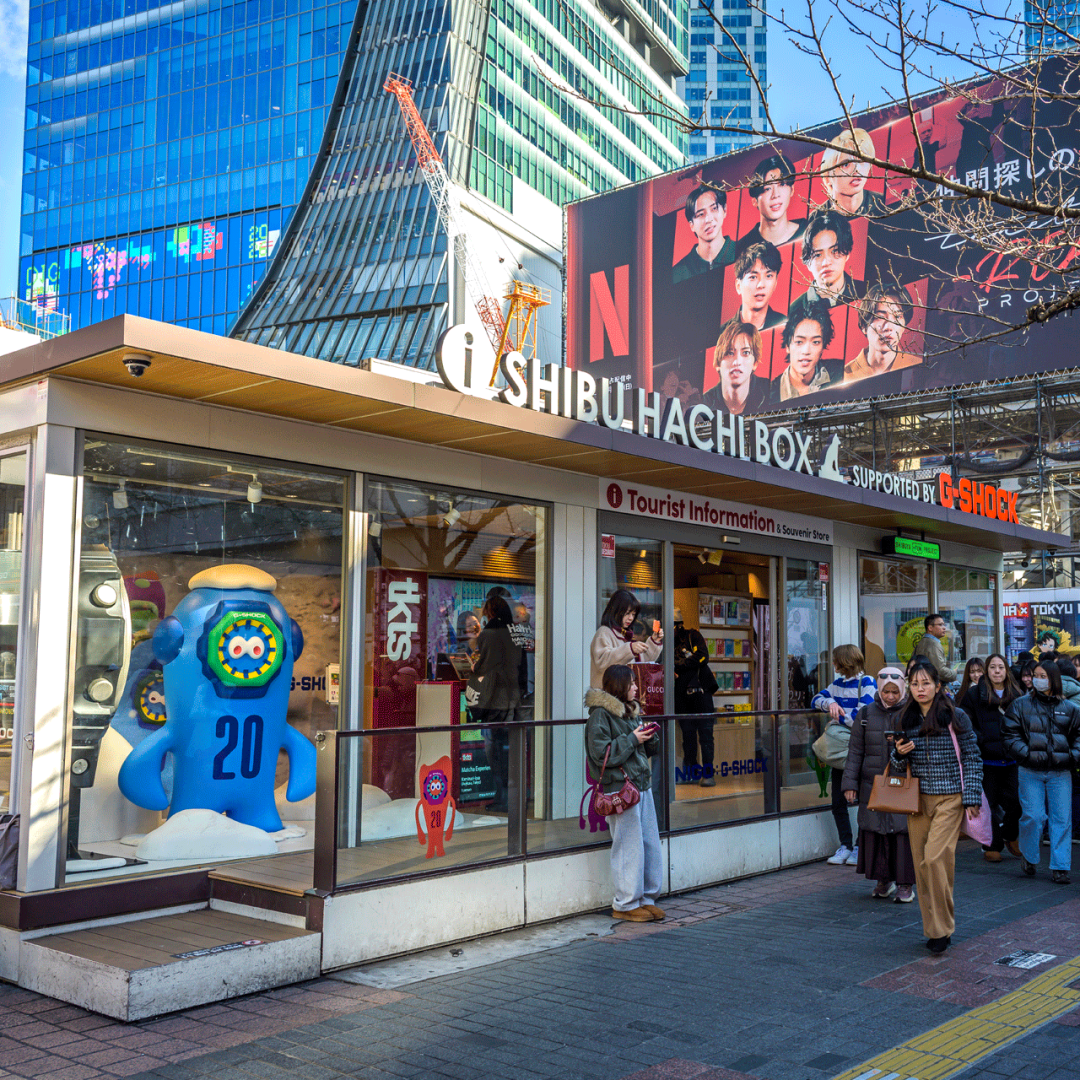
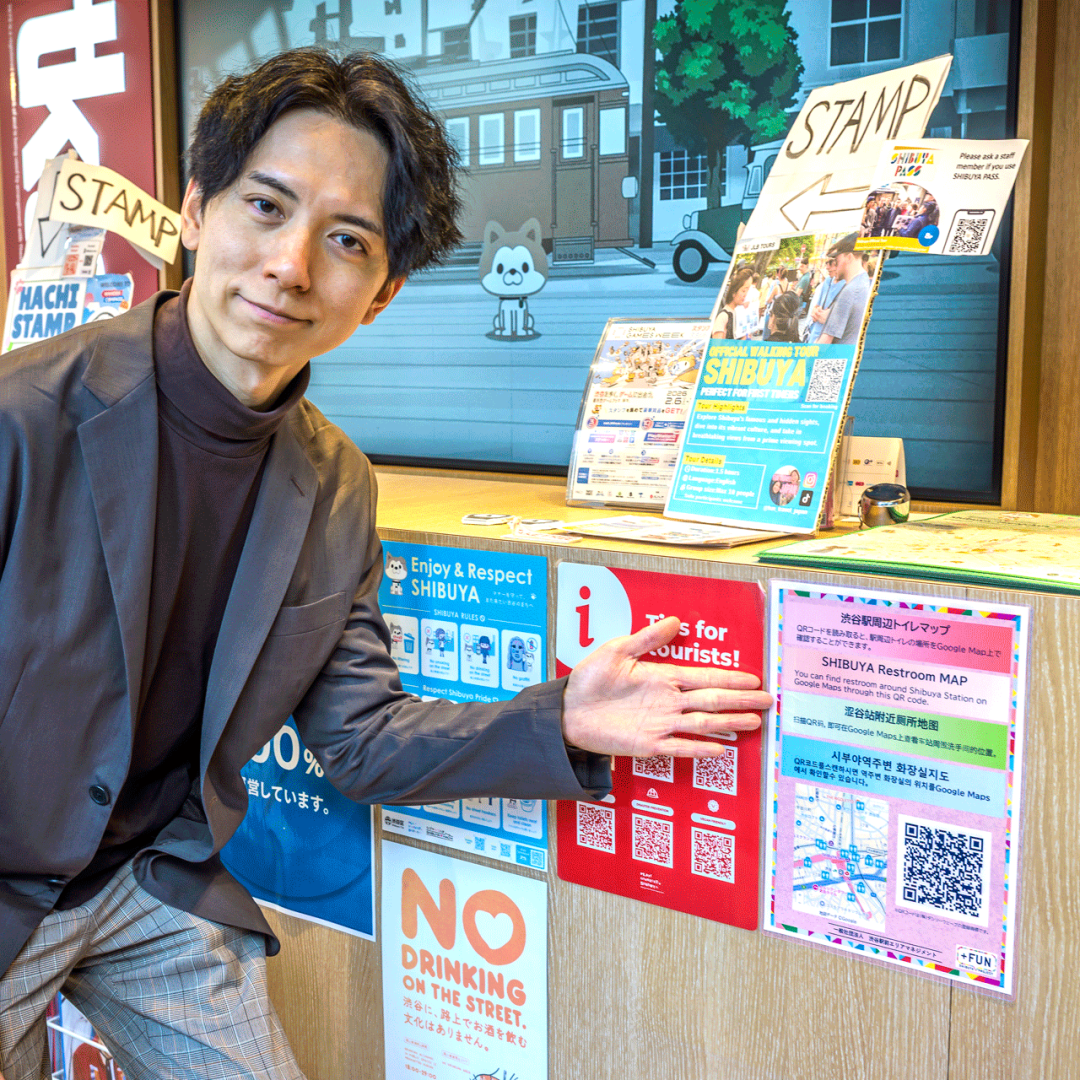
Left) The tourist information facility "SHIBU HACHI BOX" in front of the Hachiko statue was also installed by Shibuya Station Area Management. They are enhancing the city's appeal and convenience by utilizing public spaces. Right) Ms. Isomoto is pointing to a "Shibuya Station Area Toilet Map" displayed at the tourist information center. It is also available in foreign languages, and the area management supports these meticulous services for tourists.
Furthermore, the cafe "UPLIGHT COFFEE" located in the underground plaza at the east exit is also one of the facilities developed by Shibuya Station Area Management.
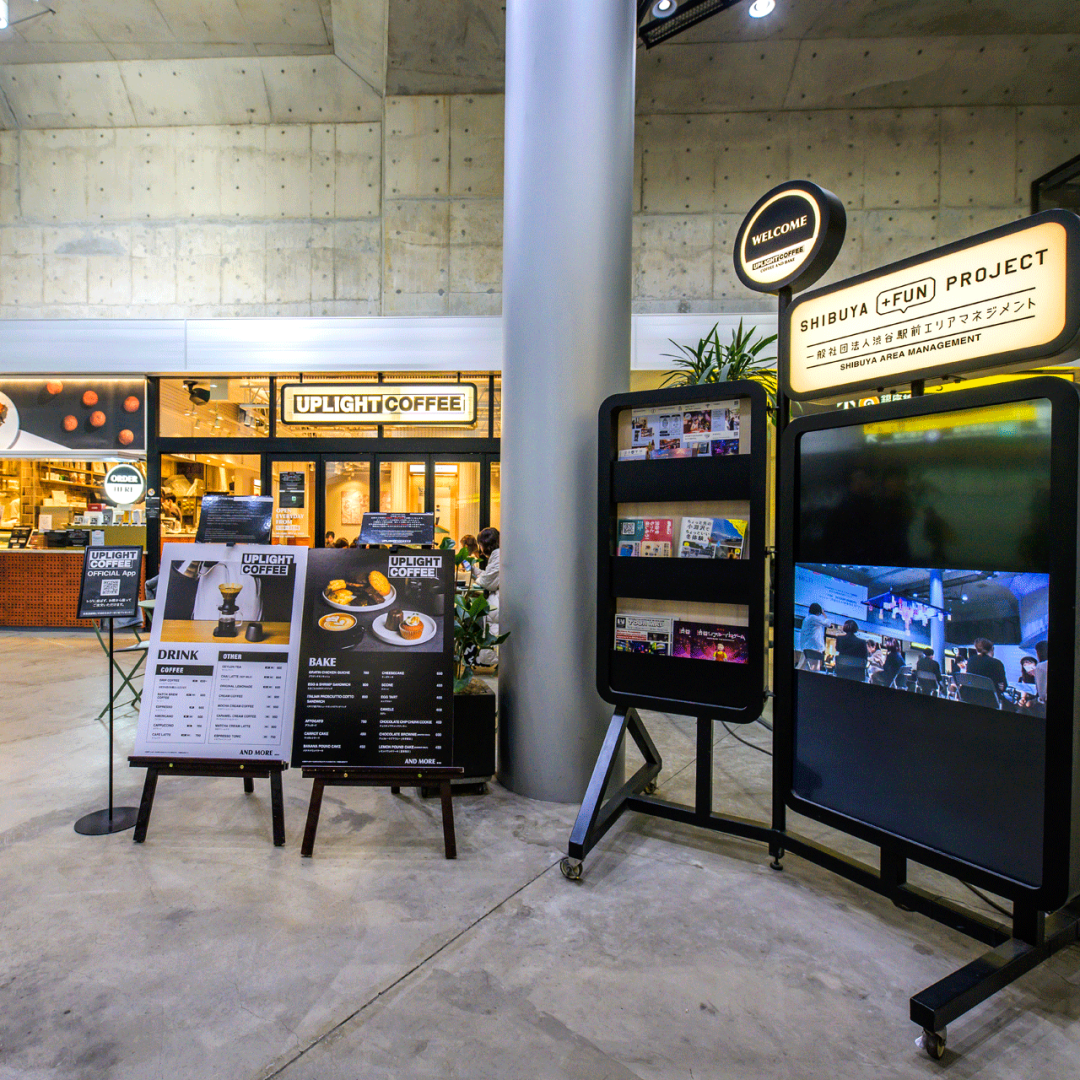
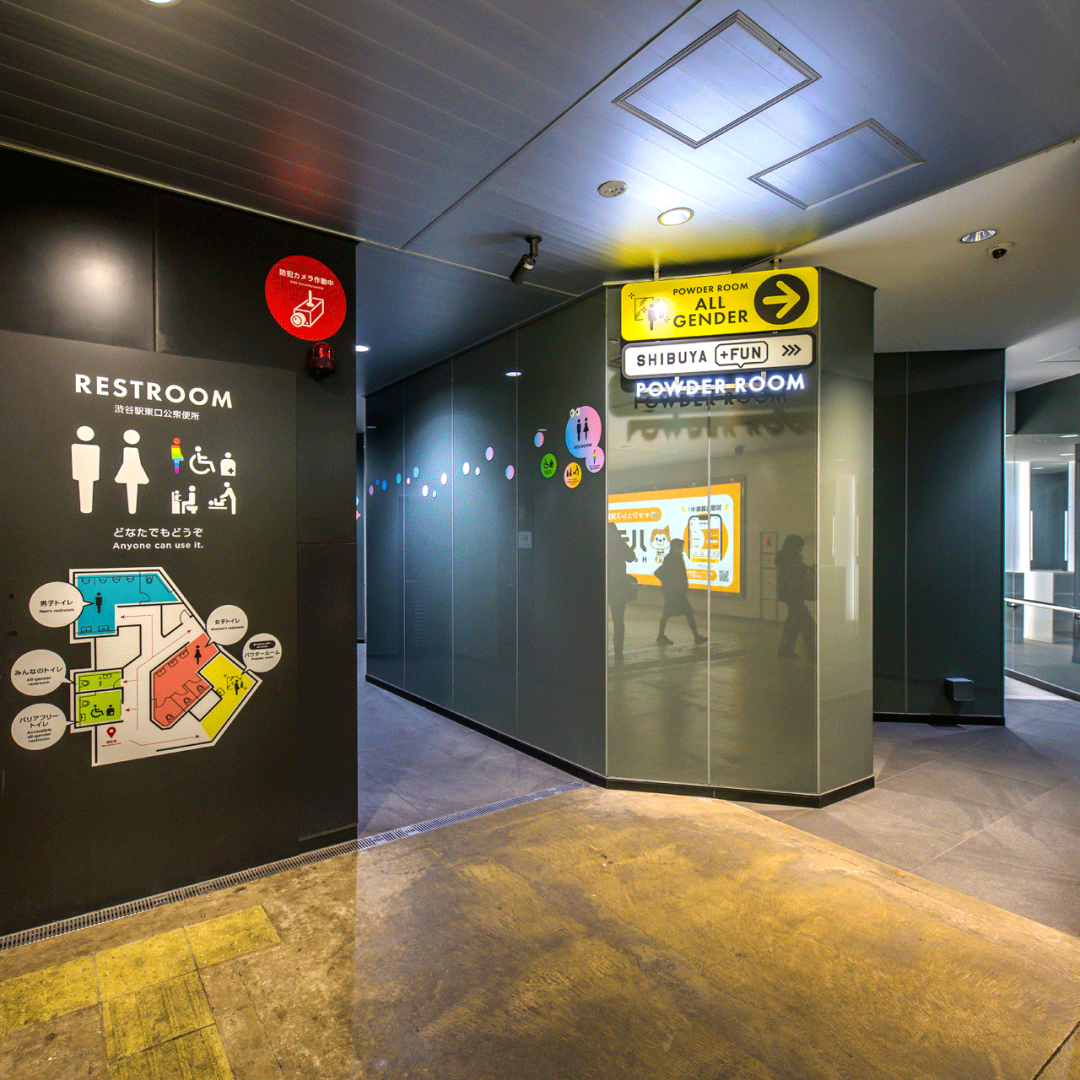
"UPLIGHT COFFEE" (left) in the East Exit Underground Plaza (B2F), and the public toilets and powder room (right) on B1F. As part of the utilization of public space, the cafe and public toilets are also maintained and operated.
"We were designated as an urban regeneration promotion corporation and were able to utilize the special provisions for road occupancy stipulated in the Urban Regeneration Special Measures Act to carry out the development. Normally, it would be difficult to install in this location, but it was made possible because of the Shibuya Station Area Management project," said Isomoto.
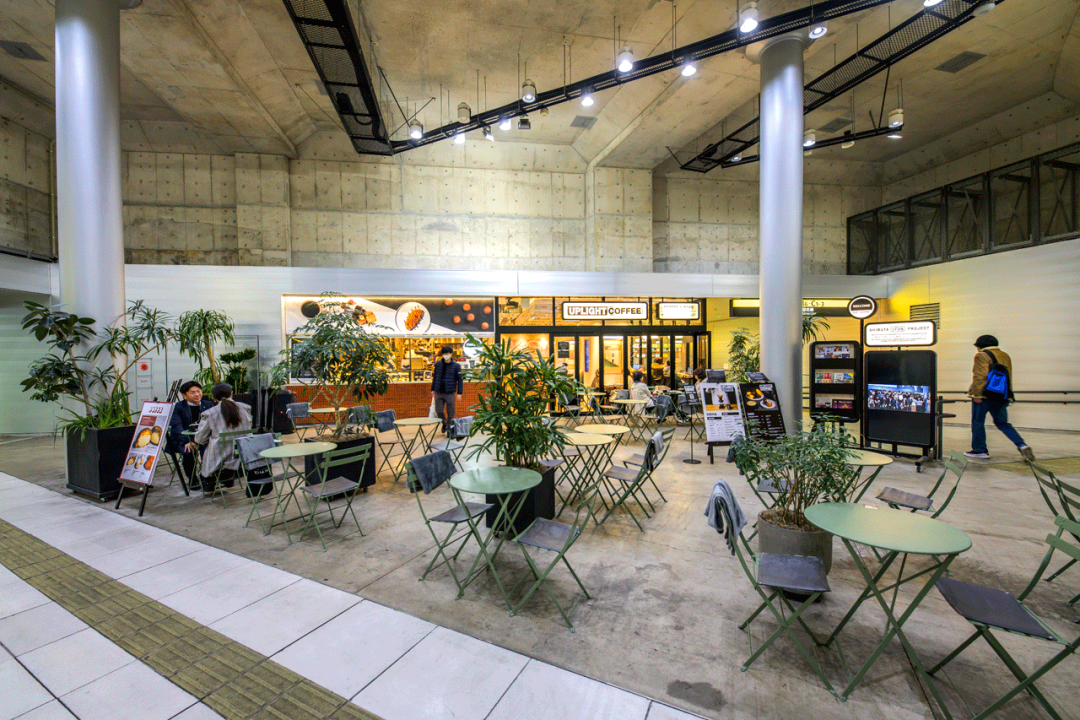
It's also possible to completely take over the Shibuya Station East Exit underground plaza (B2F) floor, where UPLIGHT COFFEE is located, with advertising covering 360 degrees.
This cafe is not just a restaurant; it's also part of an initiative to expand the use of public spaces. A portion of the rental fees and sales are returned to the Shibuya Station area management, making it a revenue source in addition to advertising.
In addition, they are also focusing on improving the city's landscape through initiatives such as "TYPELESS," which involves covering pillars with art as a countermeasure against stickers and graffiti, and art projects that bring vibrant colors and dynamism to the otherwise uninspiring temporary construction fences.
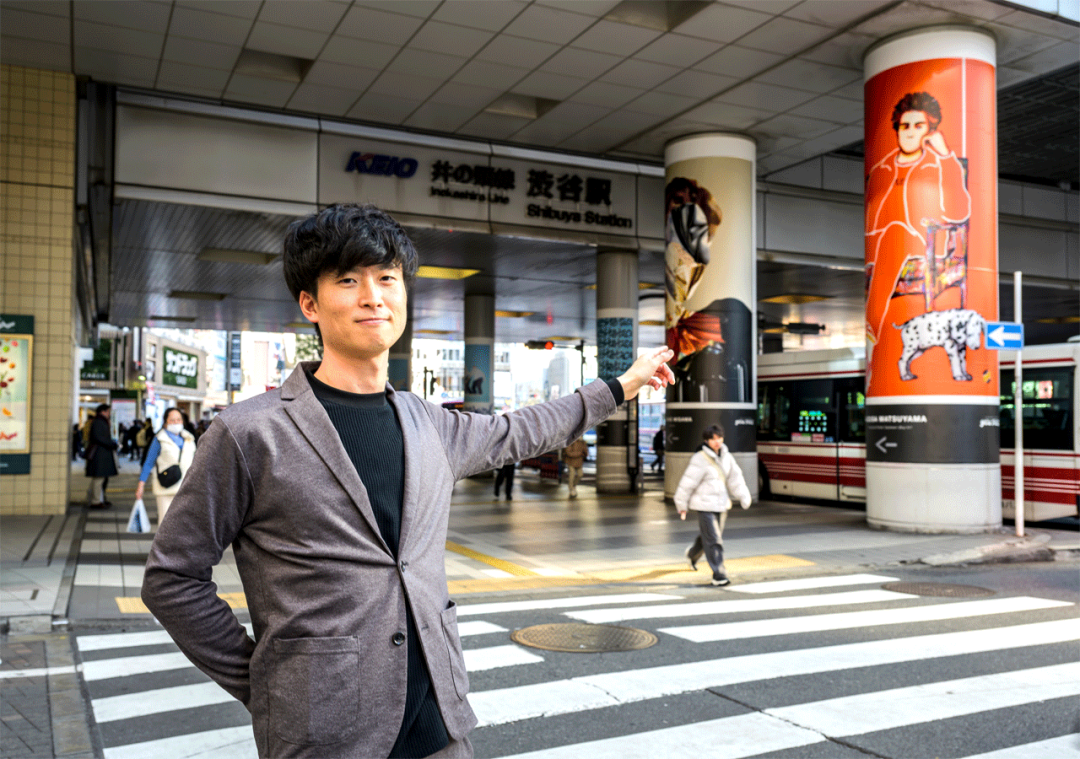
"We are developing a publicly solicited art project called TYPELESS," says Kashiwagi, using the pillars in front of Shibuya Station on the Keio INOKASHIRA LINE Line as a canvas. He explains that this project is not only a measure against graffiti but also creates opportunities for young artists to challenge themselves.
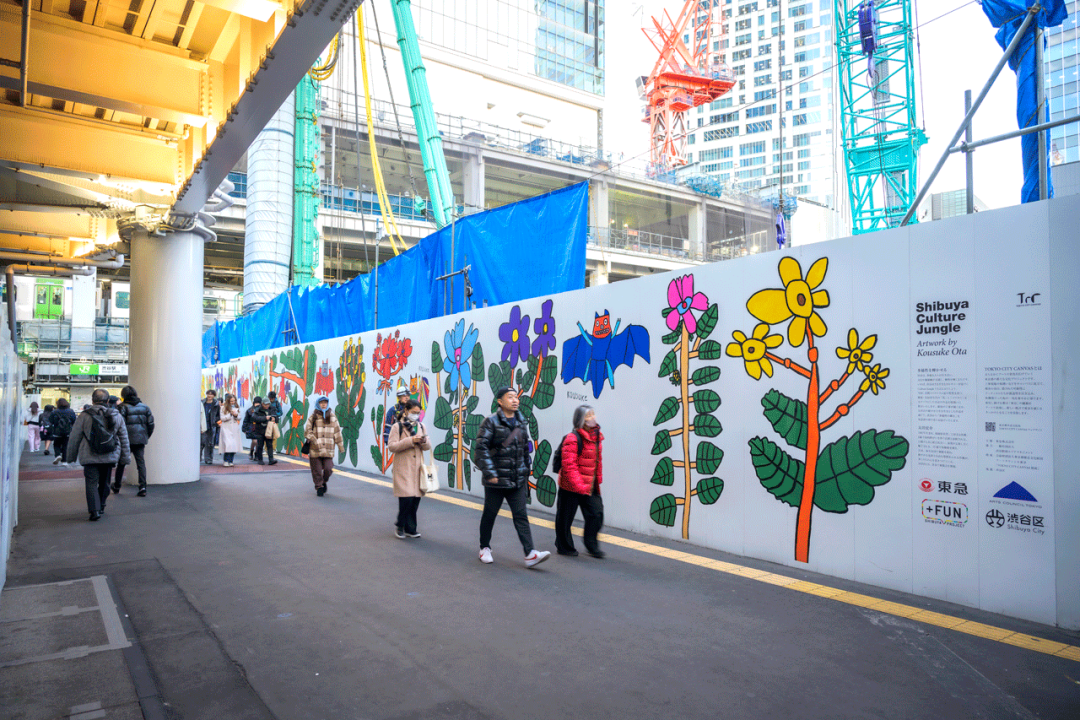
An art project with the theme "Shibuya Culture Jungle - Shining Diversity" is also being carried out on the north side of the temporary enclosure of the "SHIBUYA SCRAMBLE SQUARE West Building New Construction Project" along the walkway from the west exit of JR Shibuya Station. Works by artist Kosuke Ota, who has severe autism and intellectual disabilities, are displayed on the walls.
Beyond Shibuya's redevelopment: The changing space in front of the station and the future of advertising
As redevelopment progresses, the space in front of Shibuya Station will continue to change. As the shape of the plaza and the layout of buildings change, the nature of advertising will naturally be affected. The advertising space involved in Shibuya Station Area Management is no exception.
"We are working with businesses and experts to examine the types and number of media outlets necessary for sustainable area management activities that look to the future. The challenge is balancing landscape preservation with profitability," says Isomoto.
The Shibuya Station Area Management Association, a general incorporated association, has also reached its 10th anniversary and is working on developing its next policy.
"Advertising is essential as a stable source of revenue. On top of that, we want to contribute to creating media that allows for a wider variety of expression," says Isomoto.
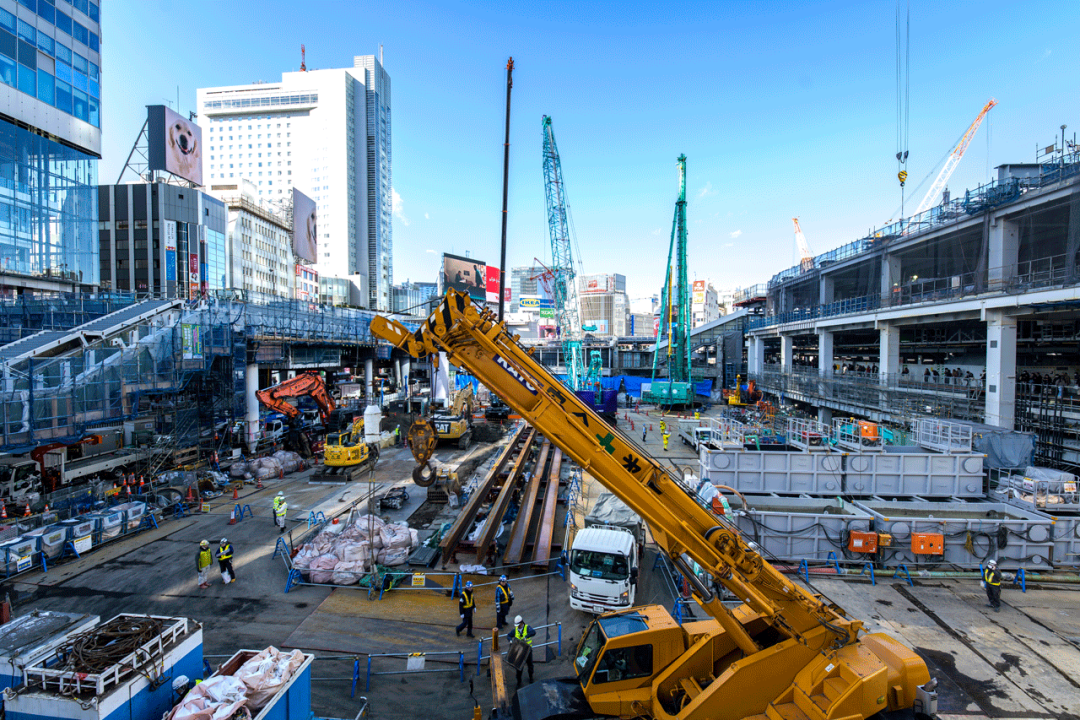
Shibuya Station is currently undergoing large-scale redevelopment work, with completion scheduled for fiscal 2034.
Behind the glamour of the station's advertisements, the everyday work of maintaining the town continues. It's not flashy, but it's an essential effort to maintain the town. When you think about it this way, the scenery in front of Shibuya Station looks a little different.
Interview and writing: Ryota Ninomiya / Photography: Osamu Matsuba
Genres within watch
Articles in the same genre
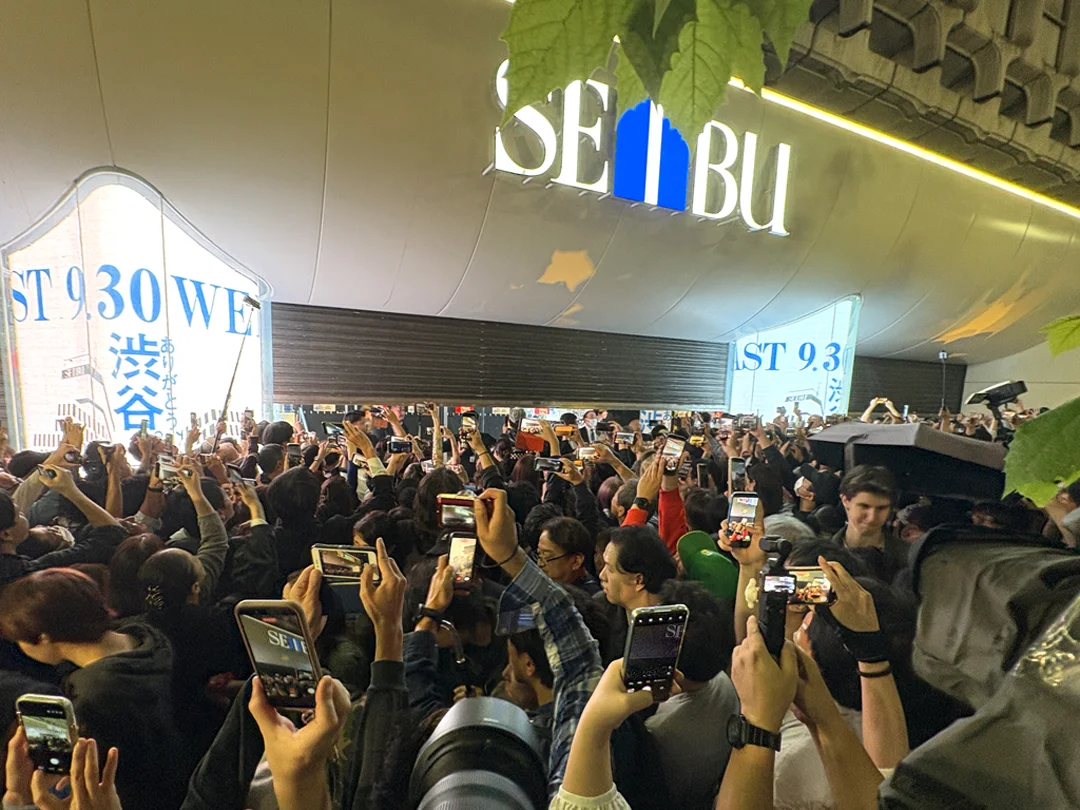
2026-09-30〜
西武渋谷店、58年の歴史に幕 「シブヤ」をつくった百貨店、最後のシャッター
![[Shibuya Scenery Records Vol. 2] The "Onko Gakkai Kaikan" continues to preserve the legacy of blind scholar Hanawa Hokiichi](https://biz.shibuyabunka.com/storage/images/watch//1787122066.webp)
2026-09-02〜
[Shibuya Scenery Records Vol. 2] The "Onko Gakkai Kaikan" continues to preserve the legacy of blind scholar Hanawa Hokiichi
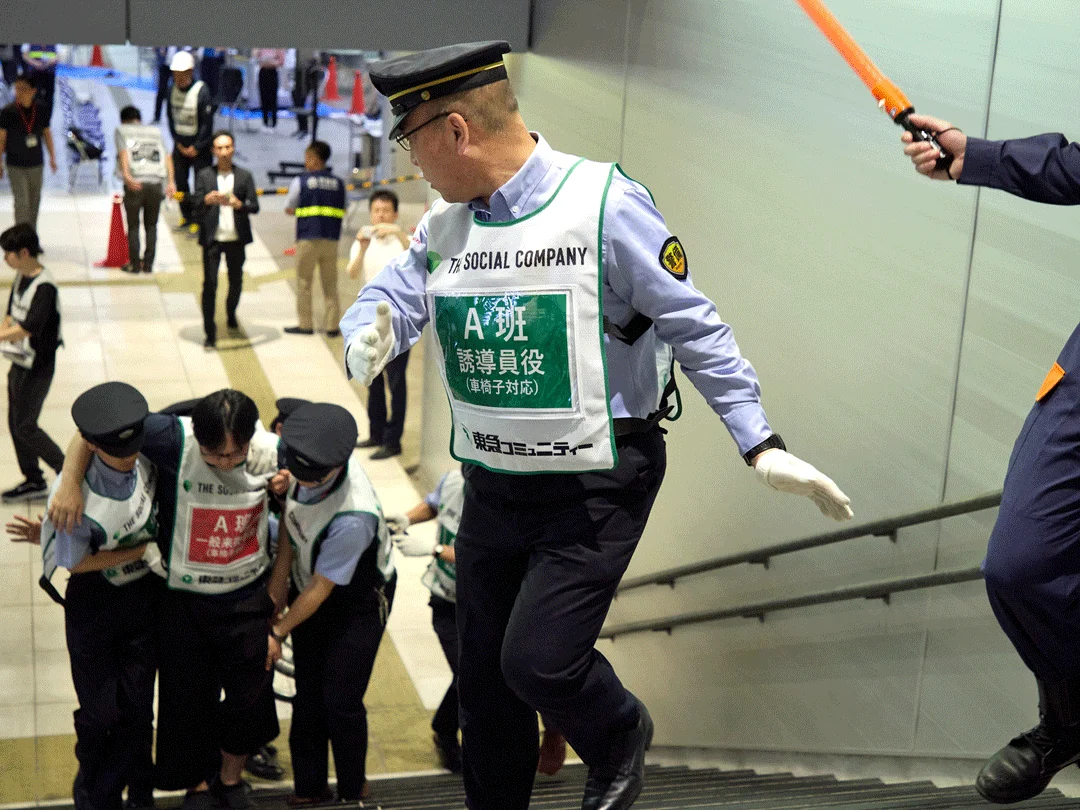
2026-08-10〜
To ensure the safe guidance of visitors during flooding, a joint drill led by local residents was held for the first time around Shibuya Station.
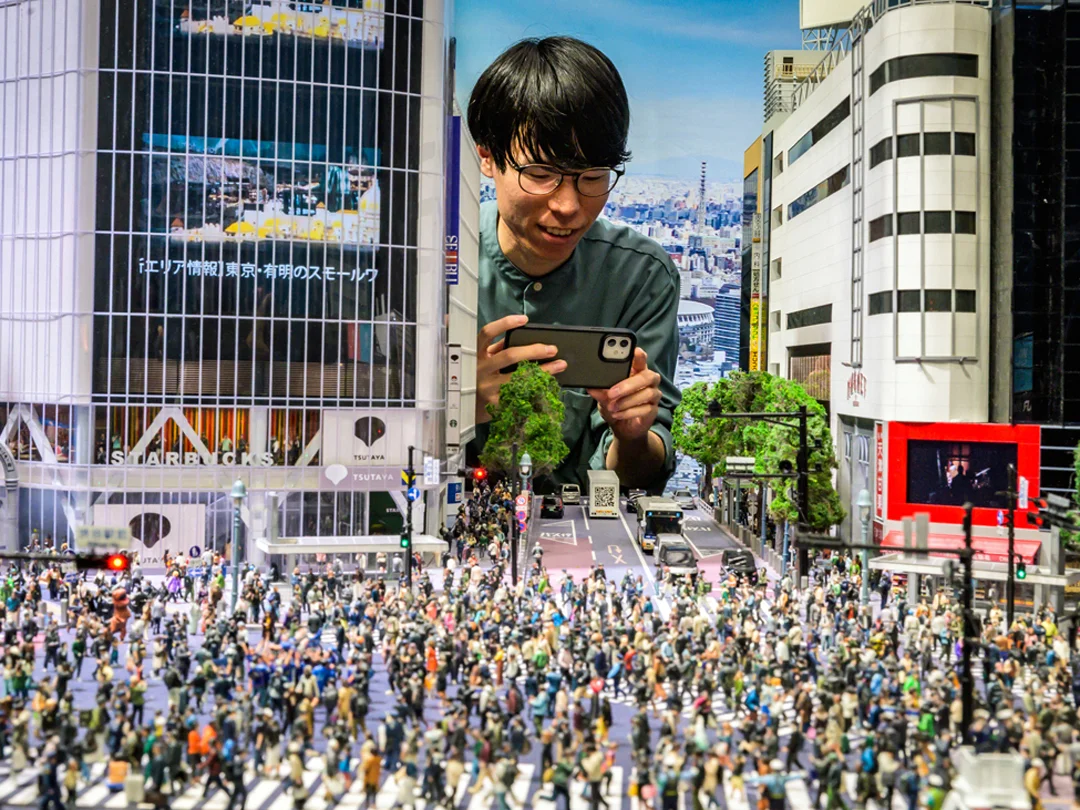
2026-07-08〜
A 1/80 scale diorama of Shibuya is born: Urban modeler Yu Irimajiri talks about the charm of Shibuya.
Featured articles on the site
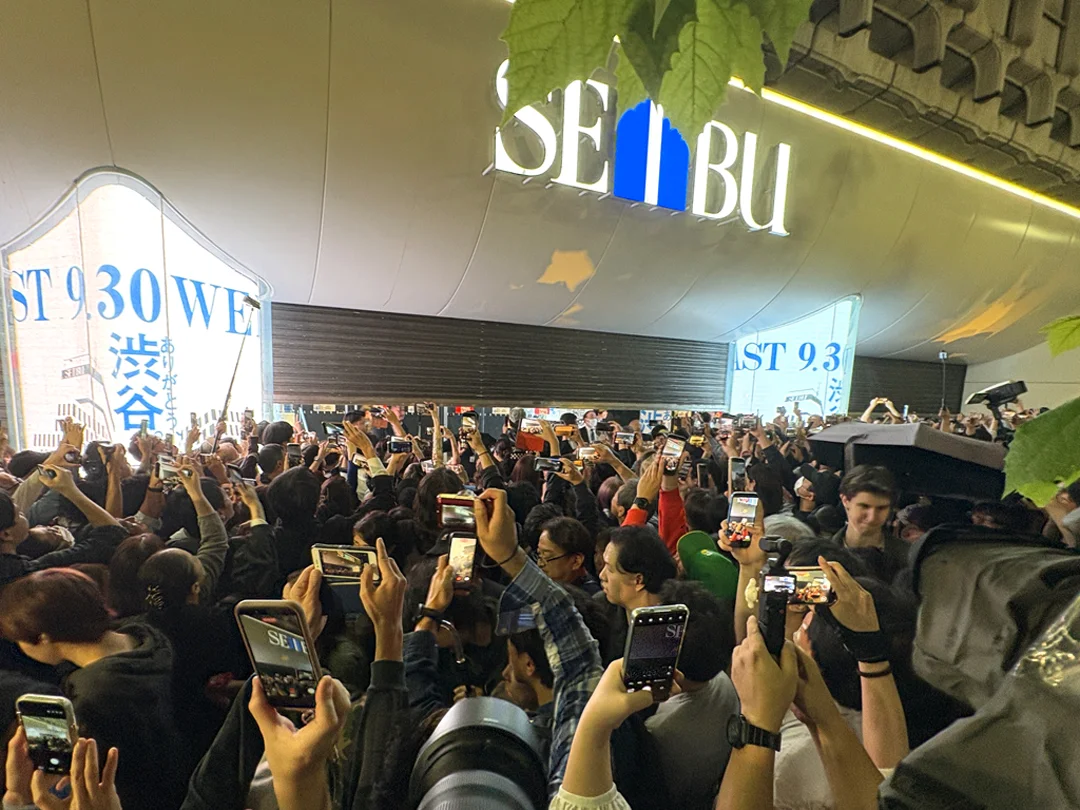
西武渋谷店、58年の歴史に幕 「シブヤ」をつくった百貨店、最後のシャッター

渋谷の肉料理おすすめ5選! 渋谷在勤・かごさんが厳選するお店を紹介
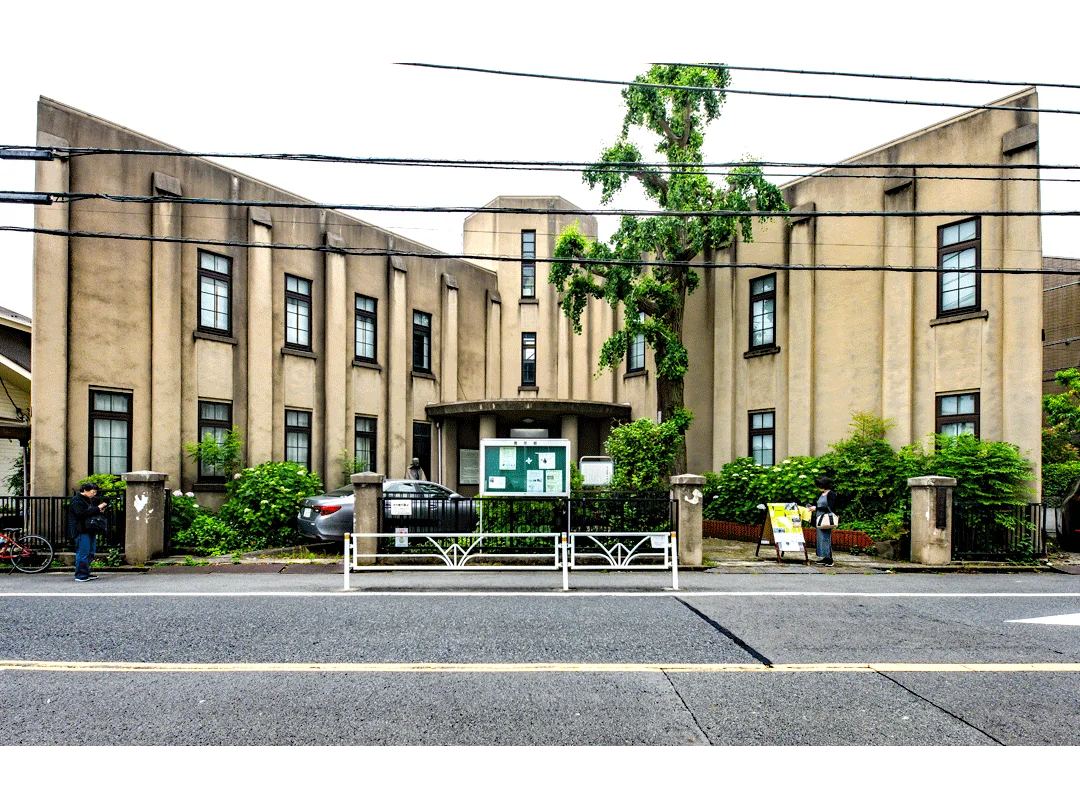
[Shibuya Scenery Records Vol. 2] The "Onko Gakkai Kaikan" continues to preserve the legacy of blind scholar Hanawa Hokiichi